
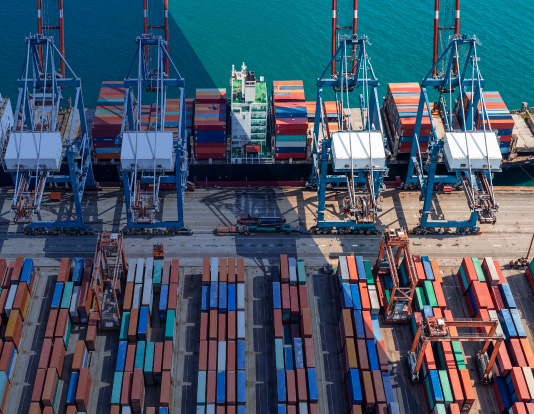
The restructuring model for the Colombian port sector
With the new public policy contained in CONPES 4118 of 2023, proposes to set aside port expansion in favor of modernizing the business model through sustainability and competitiveness guidelines, with a view to efficiently integrating ourselves into international markets and the major transitions taking place in the global maritime and port sector.
For this porpuse the Transport Ministry, in order to implement this roadmap,commissioned a crucial study for the sector in 2024, carried out by GE&A in partnership with Steer, which emphasized that such modernization should not only be aimed at technological advancement and greater logistical efficiency, but also at raising awareness and taking action on social issues, expanding planning, and ensuring sustainability through environmental care and decarbonization of ports.
However, in my opinion...
The issue is not limited to this sectoral analysis of Colombia based on the 23 actions identified in CONPES 4118 of 2024, given that global port dynamics play a significant role in the efficiency and reliability of international trade flows. The issue goes beyond the context of national public policy, as it is necessary to view the port business in Colombia with the need to:
- Digital transformation (smart ports)
- Port facilities implementations for the development of low-emission hydrogen in Colombia (Hydrogen Roadmap in Colombia)
- Advance declaration as a mechanism for facilitating foreign trade
- The "Ventanilla Única Marítima" ensures that all actors in the port system are included within the same information system.
- Climate risks and the need to adopt good environmental practices
- The blue economy implemented in ports (climate resilience and marine sustainability), as well as the possibility of Colombia becoming the alternate headquarters of:
- Nearshoring in Latin America, with the aim of encouraging different regions to attract investment in specific products and sectors. In accordance with the objectives established in the 2025 Paris Agreement (emissions reduction) and the 2030 Sustainable Development Goals (Affordable and Clean Energy, Industry Innovation and Infrastructure, Climate Change and its effects, Life Below Water).
According to what I said before:
It is clear that the maritime and port sector faces ever-greater challenges, with the need for much greater investment in improving the efficiency and adaptation of ports. In this context, the Colombian port system is no exception, as it will play a key role in the region, particularly due to the advantages of its geographical location. For this porpuse, the national government must generate incentives and legal certainty in our legal system with a view to making investments in port projects viable.
The Colombian port regime contained in Law 1 of 1991 has been a benchmark in the infrastructure sector compared to other modes of transport, as it has maintained clear rules and honored its contractual commitments with concessionaires. This has allowed private investors to view the State as an attractive partner for the development of their projects throughout these ports first generations.
However, changing the rules of the game could affect the financing of the works that should be implemented by concessionaires to bring the various ports to more competitive levels. Therefore, the challenge for the national government, in order to bring the port sector into line with international realities and sectoral competition, is to maintain the sector's confidence by demonstrating the political will to continue with the 23 actions set out in CONPES 4118 of 2023, which will certainly result in economic benefits for the country.